
The manufacturing world is changing faster than ever, and 3D printing sits at the center of that transformation. According to a recent market report, the global 3D printing industry reached over $20 billion in value in 2025 and continues to grow at a double-digit rate annually. Manufacturers across the United States are asking the same critical question: how is 3D printing used in the manufacturing industry, and how can it give them a competitive edge? This guide breaks down every major application, benefit, and real-world use case in clear, practical terms. Whether you run a small shop or a large production facility, this article delivers the answers you need.
What Is 3D Printing in a Manufacturing Context?
3D printing, also called additive manufacturing, builds objects layer by layer from digital files. Unlike traditional subtractive methods that cut away material, 3D printing adds material only where it is needed. This process reduces waste significantly and opens doors for highly complex designs. Manufacturers use a wide range of materials, including plastics, metals, ceramics, and composites. The technology has matured from a prototyping novelty into a full-scale production tool.
Key 3D Printing Technologies Used in Industry
- Fused Deposition Modeling (FDM): Best for low-cost plastic parts and tooling aids
- Selective Laser Sintering (SLS): Ideal for durable nylon and polymer components
- Direct Metal Laser Sintering (DMLS): Used for high-strength metal parts in aerospace and medical sectors
- Stereolithography (SLA): Perfect for high-detail resin parts and dental applications
- Binder Jetting: Suited for large-volume production of metal and sand casting molds
Each technology serves a specific manufacturing need, so choosing the right one depends on your material requirements, volume, and precision standards.
How Is 3D Printing Used in the Manufacturing Industry: Core Applications
Understanding how is 3D printing used in the manufacturing industry starts with its most impactful applications. These use cases span nearly every major sector in the US economy. From aerospace to consumer goods, additive manufacturing delivers measurable results. Below are the primary ways manufacturers apply this technology today.
Rapid Prototyping and Product Development
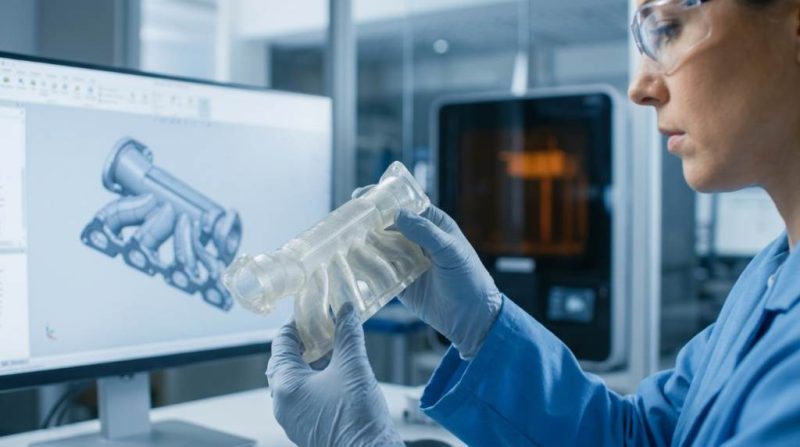
Prototyping was one of the first areas where 3D printing proved its value. Engineers can now design a part in CAD software and hold a physical prototype in their hands within hours. This speed dramatically cuts development cycles and reduces the cost of design errors. Teams iterate faster, catch problems earlier, and bring better products to market sooner. Companies like Ford and Boeing have used rapid prototyping to shorten development timelines by weeks.
Custom Tooling, Jigs, and Fixtures
3D printing has transformed how manufacturers create shop floor tools. Custom jigs and fixtures that once took days to machine can now be printed overnight. These tools hold parts in place during assembly, welding, or inspection. Printing them on demand also means teams can adapt tools quickly when production changes. This flexibility reduces downtime and keeps assembly lines running efficiently.
End-Use Part Production
More manufacturers now use 3D printing to produce final parts, not just prototypes. This is especially true for low-volume, high-complexity parts where traditional tooling costs are hard to justify. Aerospace companies produce lightweight structural brackets and ducting directly from printers. Medical device makers create patient-specific implants and surgical tools on demand. The ability to produce end-use parts without dedicated tooling changes the economics of small-batch manufacturing entirely.
Spare Parts and On-Demand Manufacturing
Supply chain disruptions have pushed manufacturers to rethink how they source spare parts. 3D printing enables an on-demand parts strategy where a digital file replaces a physical inventory item. When a machine breaks down, the facility prints the needed part rather than waiting weeks for a shipment. This approach is especially powerful for legacy equipment where original parts are no longer available. US military and defense contractors have already adopted this model to reduce logistics costs significantly.
Mass Customization
Traditional manufacturing struggles with customization because it requires unique tooling for each variation. 3D printing removes that barrier entirely since each print can be different with no additional setup cost. Footwear brands like Adidas have used additive manufacturing to offer personalized midsoles based on individual foot scans. Hearing aid manufacturers have used 3D printing for years to produce custom-fit devices at scale. This ability to deliver mass customization is one of the strongest arguments for how is 3D printing used in the manufacturing industry today.
Industry-Specific Applications
Aerospace and Defense
The aerospace sector was among the first to adopt additive manufacturing at scale. Parts for jet engines, satellite structures, and UAV components are now regularly 3D printed in titanium and nickel alloys. GE Aviation has printed thousands of fuel nozzles for the LEAP engine, achieving better performance and 25% weight reduction compared to machined versions. Weight savings directly translate to fuel efficiency, which is critical in aviation. Defense agencies use 3D printing to manufacture parts in the field, reducing reliance on distant supply chains.
Automotive Manufacturing
Automakers use 3D printing throughout the product lifecycle, from early concept models to final production tooling. Companies like GM and Tesla use additive manufacturing to create lightweight structural components that reduce vehicle weight. Custom fixtures and assembly aids are printed on-site, cutting the time and cost of ordering from external suppliers. Electric vehicle manufacturers benefit especially since battery housings and mounting brackets often require complex geometries. The shift to EV production has accelerated adoption of 3D printing across the automotive supply chain.
Healthcare and Medical Devices
The healthcare sector demonstrates some of the most powerful examples of how is 3D printing used in the manufacturing industry. Hospitals and medical device companies print patient-specific surgical guides, prosthetics, and implants tailored to individual anatomy. Dental labs use SLA printers to produce crowns, bridges, and aligners with impressive speed and accuracy. Bioprinting research continues to advance toward printing living tissue for transplantation purposes. The FDA has cleared hundreds of 3D-printed medical devices for use in the United States.
Consumer Electronics
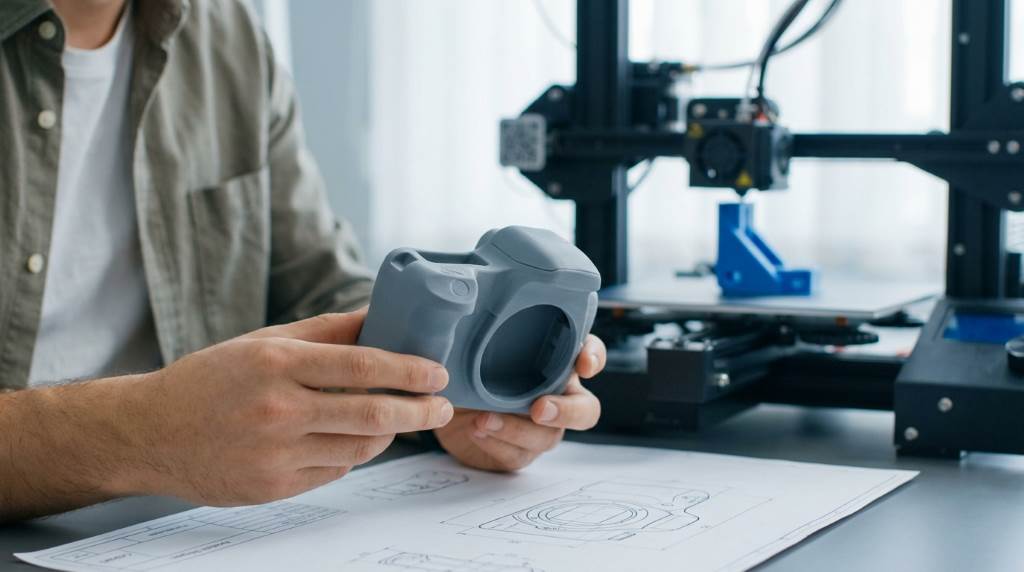
Electronics manufacturers use 3D printing to create housings, enclosures, and internal structural components. The technology allows engineers to test ergonomics and form factor before committing to expensive injection molds. Companies also use printed jigs and fixtures to assemble delicate electronic components accurately. As miniaturization trends continue, 3D printing supports the production of intricate micro-scale components. This makes it a key enabler of next-generation device development.
Construction and Architecture
Large-format 3D printing is emerging as a genuine construction method in the United States. Companies like ICON have printed entire homes in Texas using concrete-extrusion printers. Architects use scale models printed quickly from digital blueprints to validate designs before construction begins. Custom facade elements and structural components can be printed with geometries impossible through conventional forming methods. As material science improves, construction 3D printing is moving from novelty to mainstream application.
Benefits of 3D Printing for Manufacturers
Manufacturers choose 3D printing because it delivers real, measurable advantages:
- Reduced lead times: Parts are available in hours instead of days or weeks
- Lower tooling costs: No molds or dies are required for production
- Design freedom: Complex internal geometries are possible without assembly
- Material efficiency: Additive processes generate far less waste than machining
- Supply chain resilience: Digital inventories reduce dependency on physical stock
- Customization at no extra cost: Each unit can differ without retooling
These benefits explain why US manufacturers continue to invest heavily in additive manufacturing infrastructure.
Challenges and Considerations
While the advantages are significant, manufacturers should also understand the current limitations. Surface finish quality from 3D printing often requires post-processing such as sanding, painting, or heat treatment. Build volume limits restrict the size of parts that a single printer can produce. Material costs for high-performance metals and composites remain higher than bulk raw materials used in casting. Quality control and certification processes for 3D-printed parts require rigorous validation, especially in aerospace and medical applications. Addressing these challenges requires investment in both equipment and workforce training.
The Future of 3D Printing in Manufacturing
The trajectory of additive manufacturing points toward broader adoption and deeper integration. Multi-material printing will allow manufacturers to print parts with embedded electronics, sensors, or structural reinforcements in a single build. Artificial intelligence will optimize print parameters automatically to reduce failures and improve quality. Distributed manufacturing networks will enable companies to print parts at or near the point of use anywhere in the world. As print speeds increase and material costs fall, more production volumes will shift to additive processes. Understanding how is 3D printing used in the manufacturing industry today prepares businesses to lead in the next phase of industrial evolution.
Conclusion
3D printing has moved far beyond the laboratory and into the heart of modern production. From aerospace brackets to personalized medical implants, the applications are broad, practical, and growing rapidly. Manufacturers who embrace this technology reduce costs, speed up development, and gain the flexibility to meet changing customer demands. If you have not yet evaluated how additive manufacturing fits your production strategy, now is the time to start. Connect with a certified additive manufacturing consultant or request a pilot project to see the real-world impact firsthand. The question is no longer whether 3D printing belongs in manufacturing; it is how quickly you can make it work for you.
Frequently Asked Questions
What industries benefit most from 3D printing in manufacturing?
Aerospace, automotive, healthcare, defense, and consumer electronics benefit the most due to their need for complex, lightweight, and customized parts.
Is 3D printing cost-effective for large-scale manufacturing?
It is most cost-effective for low-volume, high-complexity parts, though advances in speed and materials are making it viable for larger production runs.
What materials can manufacturers use in 3D printing?
Manufacturers commonly use plastics, metals such as titanium and stainless steel, ceramics, composites, and biocompatible resins depending on the application.
How does 3D printing improve supply chain resilience?
It enables on-demand production from digital files, eliminating the need for physical inventory and reducing dependency on distant suppliers.
How long does it take to 3D print a manufacturing part?
Print time ranges from a few hours for small plastic components to several days for large or complex metal parts, depending on size, material, and technology.

Leave a Reply