

You can start learning machine learning from scratch this year, even with zero coding background. All you need is a laptop, a bit of daily time, and the right learning order. This guide gives you that order.
Most beginners fail for one simple reason. They jump straight into deep learning before they understand the basics. This article fixes that. It walks you through the exact skills to learn, in the exact order to learn them.
By the end, you will have a clear 90-day roadmap. You will also know which tools to use and which ones to skip.
What You Actually Need Before You Start Learning ML
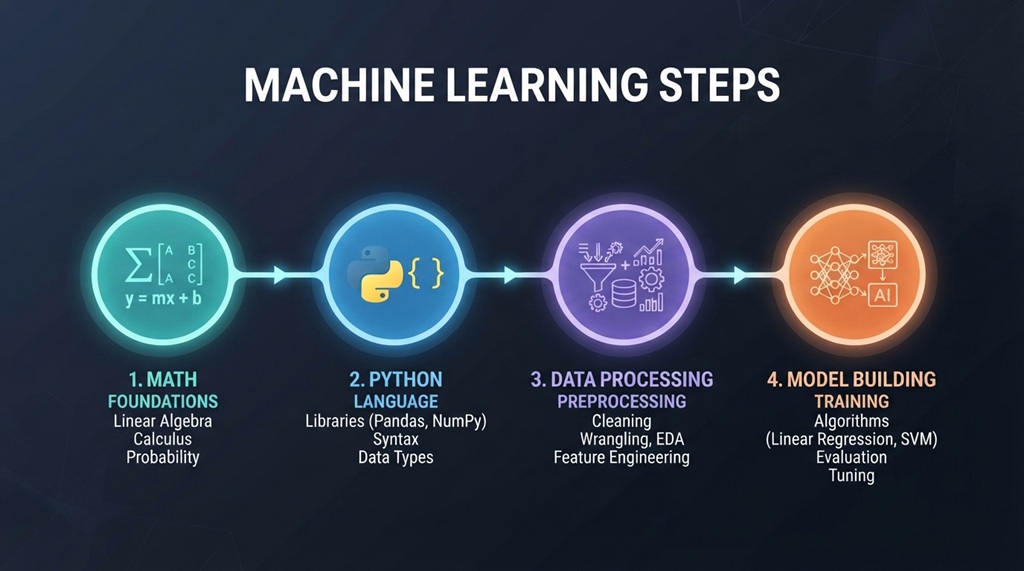
You need three things before you touch machine learning: basic math, basic Python, and patience. You do not need a computer science degree. You do not need a powerful GPU either.
The Math You Really Need
You need three areas of math: linear algebra, basic statistics, and simple calculus. This sounds scary, but the bar is low. You mainly need to understand vectors, averages, and how a function changes.
Most beginners over-study math and under-practice code. Spend no more than two weeks on math refreshers. Then move into hands-on projects, where the math will make more sense anyway.
Essential Coding Skills for Beginners
Python serves as the universal foundation for machine learning, but you don’t need to master the entire language to begin. Focus on fundamental building blocks first: variables, loops, functions, and basic data structures while bypassing complex software architecture until later in your journey. Once you are comfortable with these core concepts, transition to two indispensable libraries: NumPy, which handles high-performance numerical operations, and Pandas, which streamlines data manipulation through structured tables. Together, these tools form the core ecosystem for almost every real-world machine learning project. To fast-track this learning process, pair these fundamentals with modern workflows by exploring code using AI assistants even as a beginner to accelerate your growth without getting bogged down by syntax errors.
The Best Order to Learn Machine Learning Concepts
Learn concepts in this order: data handling, supervised learning, unsupervised learning, then neural networks. This order matches how real ML projects actually work.
Step 1: Learn to Clean and Explore Data
Every ML project starts with messy data. Learn how to load a dataset, handle missing values, and spot outliers. This step feels boring, but it teaches you more about real-world ML than any theory lesson.
Step 2: Learn Supervised Learning
Supervised learning means training a model on labeled examples. Start with linear regression and logistic regression. These two algorithms are simple, but they teach you the core workflow you will reuse everywhere: train, test, and evaluate.
Step 3: Learn Unsupervised Learning
Unsupervised learning means finding patterns without labels. Clustering is the easiest place to start. Try grouping customers by purchase behavior, for example. This builds intuition for how models find structure on their own.
Step 4: Learn Neural Networks Last
Neural networks come last, not first. Many beginners try to jump straight into deep learning and get overwhelmed. Once you understand basic ML models, neural networks feel like a natural next step instead of a wall you cannot climb.
Tools and Platforms Beginners Should Actually Use
Beginners should use Google Colab, Kaggle, and Scikit-learn. These three tools cover almost everything you need in your first six months, and all of them are free.
- Google Colab runs Python code in your browser. You do not need to install anything.
- Kaggle hosts free datasets and beginner-friendly competitions.
- Scikit-learn is a Python library built for classic ML algorithms.
Skip TensorFlow and PyTorch until you finish your first few projects. These tools are powerful, but they add complexity you do not need yet. Save them for when you start building neural networks.
A Realistic 90-Day Learning Plan

You can build real ML skills in 90 days if you follow a structured plan. This plan assumes about one hour of study per day.
Days 1-14: Foundations Learn basic Python and light math review. Build small scripts, not full projects yet.
Days 15-35: Data Skills Practice cleaning and exploring datasets with Pandas. Use real datasets from Kaggle instead of toy examples.
Days 36-60: Core ML Models Build your first supervised learning projects. Try predicting house prices or classifying emails as spam.
Days 61-80: Unsupervised Learning and Evaluation Learn clustering and model evaluation metrics. Understand why accuracy alone can be misleading.
Days 81-90: Your First Portfolio Project Pick one dataset and build a complete project from start to finish. Document it clearly, since this becomes your first portfolio piece.
The One Mistake Almost Every Beginner Makes
Most beginners collect too many courses instead of finishing projects. This is the mistake that quietly kills momentum for most self-taught learners.
Here is the fix nobody tells you: pick one project and finish it badly before you pick a better one. A finished, imperfect project teaches you more than three half-watched courses. It forces you to debug real errors, which is where actual learning happens.
Track your progress by projects completed, not courses started. This single change in mindset speeds up learning more than any tool or course ever will.
How to Know You’re Ready for the Next Level
You are ready to move beyond beginner content once you can build a simple ML model without a tutorial open. This usually happens after three to five completed projects.
At that point, look into intermediate topics: feature engineering, model tuning, and basic deep learning. You will also be ready to start applying for entry-level ML or data roles, or contributing to open-source projects, depending on your goals.
Frequently Asked Questions
Do I need a degree to learn machine learning?
No, a degree is not required. Many working ML practitioners are self-taught or came from unrelated fields. What matters most is a strong portfolio of completed projects.
How long does it take to learn machine learning from scratch?
Most beginners reach a solid, job-relevant foundation in six to twelve months of consistent practice. Progress depends heavily on daily time invested, not raw talent.
Is Python the only language used in machine learning?
Python is the most common language, but not the only one. R and Julia are also used, especially in research and statistics-heavy fields, though Python has the largest beginner ecosystem.
Can I learn machine learning without a powerful computer?
Yes, you can. Free cloud tools like Google Colab let you train models without a strong local GPU, which is more than enough for beginner and intermediate projects.
What should I build as my first machine learning project?
Start with a simple, well-known problem like predicting house prices or classifying spam emails. Simple problems let you focus on the workflow instead of getting stuck on data complexity.
Final Thoughts
Starting machine learning from scratch this year is realistic if you follow a clear order: math basics, Python, data handling, then core ML models. Skip the temptation to collect endless courses. Finish real projects instead, since that is what actually builds skill and confidence.
Stick to the 90-day plan in this guide, and you will have a working project and a real understanding of ML fundamentals by the end of it.

Leave a Reply