

AI workflow tools let you automate daily tasks by connecting your apps and letting AI handle the repetitive steps in between. You set up a trigger, like a new email or a form submission. The tool then acts on it sorting, replying, updating, or notifying without you lifting a finger.
This guide breaks down exactly how these tools work, which ones fit different needs, and how to build your first automation today. Best of all, you don’t need to code or spend a big budget. Instead, you just need fifteen minutes and a task you’re tired of doing by hand.
By the end, you’ll know how to turn your busiest daily chores into background processes that run themselves.
What Are AI Workflow Tools and How Do They Work
AI workflow tools connect your apps and use artificial intelligence to decide what happens next, instead of just moving data from one place to another. Traditional automation follows fixed rules: if X happens, then do Y. AI workflow tools, however, go further. <cite index=”2-1″>They can interpret inputs, understand context, and decide what action should happen next.</cite>
This matters because real work is messy. For example, an email might be a customer complaint, a sales lead, or spam. A rule-based tool can’t easily tell the difference. An AI-powered tool, on the other hand, can read the message, sort it, and send it to the right place.
The Basic Building Blocks
Every AI workflow tool uses three core pieces. First, a trigger starts the process, such as a new file, message, or calendar event. Next, an action step processes that input, often using AI to summarize, sort, or write content. Finally, a connector sends the result somewhere useful, like a Slack channel or a spreadsheet.
Once these three pieces are in place, the workflow runs on its own. As a result, you only step in when something needs your judgment.
Why You Should Automate Your Daily Tasks with AI
Automating daily tasks frees up time for work that actually needs your brain. After all, status updates, data entry, meeting notes, and inbox sorting eat hours every week. None of it requires creativity, and all of it can run in the background instead.
<cite index=”7-1″>Across customer support, HR, IT, and operations, teams are adopting AI to automate repetitive tasks, integrate fragmented systems, and make informed decisions more efficiently.</cite> The same logic applies to a single freelancer or a two-person team. In other words, you don’t need an enterprise budget to see the benefit.
Common Daily Tasks Worth Automating
Start with tasks you repeat at least once a day. For instance, good candidates include:
- Sorting and replying to routine emails
- Turning meeting recordings into short notes
- Updating a spreadsheet or CRM after a form submission
- Posting the same content across multiple social channels
- Generating a daily or weekly report from raw data
Overall, if a task follows a pattern, an AI workflow tool can likely handle it.
Selecting the Optimal AI Workflow Engine
Selecting the ideal AI workflow tool hinges far more on your technical literacy than a platform’s raw feature density; after all, an overly complex system often yields shelfware, whereas an intuitive framework guarantees immediate operational adoption. Aligning software complexity with your team’s baseline competence accelerates deployment and minimizes friction across daily operations. For those looking to build custom automations rather than rely solely on off-the-shelf tools, gaining foundational insight into the underlying models is a smart precursor making it worth reading this guide on start with machine learning from scratch this year.
For Beginners
If you’ve never built an automation before, start with a no-code, drag-and-drop platform. For example, <cite index=”4-1″>Zapier is a user-friendly AI workflow automation tool designed for beginners and non-technical users</cite>, and it offers <cite index=”4-1″>starter templates for each product</cite> so you rarely start from a blank page.
For Users Who Want More Control
If you’re comfortable with logic, branching, and some light scripting, a platform like n8n gives you more freedom. Specifically, <cite index=”4-1″>n8n is best for technical users and enterprise teams seeking ultimate flexibility and cost-effective scalability</cite>, and it works well once your workflows outgrow simple, linear steps.
For Workflows That Need Human Approval
Some tasks shouldn’t run fully on their own. For instance, sending a client email or approving a budget item deserves a human check first. To address this, <cite index=”1-1″>Relay.app builds human-in-the-loop checkpoints into workflows, so you can pause a workflow mid-execution, route it to a specific person for review, and resume only after they approve.</cite> As a result, you get automation speed without losing oversight where it matters most.
Step-by-Step: Building Your First AI Automation
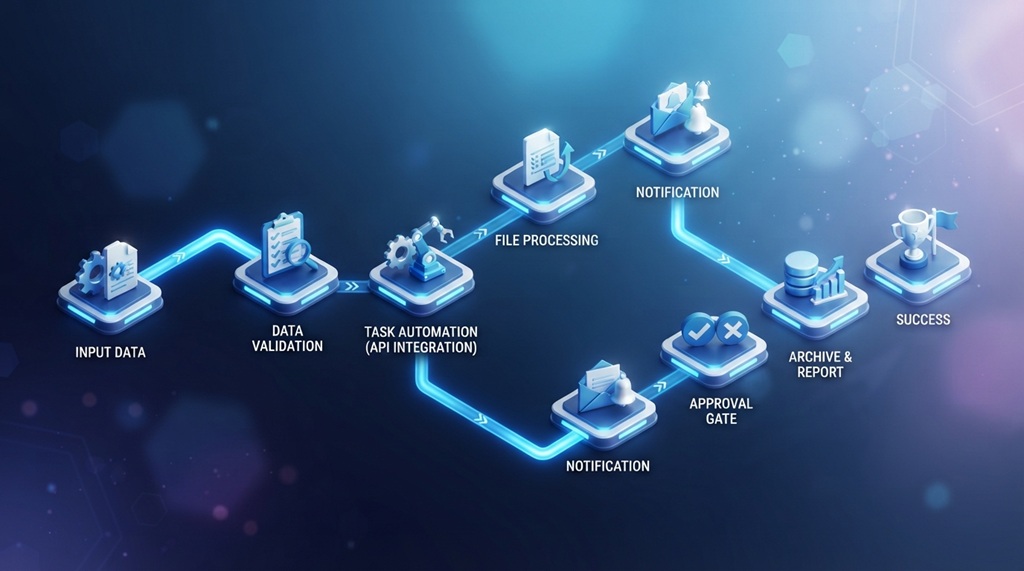
You can build a working automation in under twenty minutes, even with zero technical background. Just follow these steps in order and test as you go.
Step 1: Pick One Repetitive Task
First, choose a task you do daily or weekly that follows a clear pattern. A good first project is something low-risk, such as sorting newsletter emails into folders or turning daily sales numbers into a short message.
Step 2: Choose Your Trigger
Next, decide what starts the workflow. This could be a new email arriving, a form being submitted, or a specific time of day. Most platforms let you pick from a dropdown list of common triggers.
Step 3: Add an AI Action Step
This is where the AI does the thinking. For instance, you might ask it to summarize a document, draft a reply, or sort an item by topic. Above all, write clear instructions here, since vague prompts produce vague results.
Step 4: Connect the Output
Then, send the AI’s output somewhere useful. This might be a Slack message, a new row in a spreadsheet, or a draft email waiting in your inbox. Either way, test this step carefully before turning the workflow fully live.
Step 5: Test, Then Automate
Finally, run the workflow by hand a few times first. Check that the AI’s decisions match what you’d do yourself. Once you trust the output, switch the trigger to run on its own.
A Smarter Way to Think About Automation Costs
Most guides tell you to compare monthly prices and stop there, but that misses the real cost driver. Many platforms charge per task, and a single workflow run can count as several tasks if it has multiple steps. For example, <cite index=”18-1″>a three-step Zap running 10,000 times a month is 30,000 tasks, not 10,000.</cite>
As a result, a workflow that looks cheap in a demo can get expensive fast once it runs at real volume. So, before committing to a platform, map out how many steps your actual workflow needs and multiply that by how often it will run in a month. Then compare that number against the platform’s task-based pricing tiers, not just the advertised starting price. This one calculation avoids the most common billing surprise people run into after their first month.
Common Mistakes to Avoid When Automating Tasks
Most automation failures come from rushing setup, not from the tools themselves. So, avoid these mistakes to save yourself hours of troubleshooting later.
Automating a task before you understand it well. If you can’t clearly explain the steps you take by hand, the AI can’t copy them reliably either.
Skipping the testing phase. Always run a new workflow by hand a few times before letting it go fully on its own. Otherwise, small errors compound quickly once they’re unsupervised.
Ignoring error handling. APIs fail, files go missing, and formats change over time. Therefore, build in a fallback step, like a notification to you, so failures don’t disappear silently.
Automating high-stakes decisions without a review step. For anything touching money, client communication, or compliance, include a human checkpoint instead of full independence.
Frequently Asked Questions
Do I need coding skills to use AI workflow tools?
No. Most popular platforms, including Zapier and Make, use drag-and-drop builders made for non-technical users. As a result, you can build a working automation using dropdown menus and plain-language instructions, with no code required.
How much do AI workflow tools cost?
Pricing varies widely, from free starter plans to enterprise contracts. Generally, many tools charge based on the number of tasks or steps run each month, so cost depends heavily on your workflow’s complexity and how often it runs.
Can AI workflow tools replace my job?
They’re built to remove repetitive tasks, not entire roles. Instead, most teams use them to free up time for higher-value work like strategy, relationship-building, and creative problem-solving, rather than to eliminate positions.
What’s the difference between traditional automation and AI workflow automation?
Traditional automation follows fixed if-then rules and breaks when inputs vary. AI workflow automation, however, can interpret unstructured data, like an email or a document, and adapt its response based on context instead of a rigid script.
Which AI workflow tool should a beginner start with?
Start with a platform that offers templates and a visual builder, since you can launch your first automation without learning new concepts from scratch. For this reason, Zapier is a common starting point, thanks to its large template library and simple interface.
Conclusion
AI workflow tools turn repetitive daily tasks into background processes, giving you back hours every week without requiring technical expertise. To begin, start small: pick one task, build one workflow, and test it before scaling up. Once you see the time savings on a single process, expanding to more of your daily routine becomes an easy decision.

Leave a Reply